How should the configuration be verified and delivery completed when purchasing catering fish tanks at the store?
The delivery of catering fish tanks should begin during the order confirmation stage, rather than waiting for the transport vehicle to arrive at the store before final inspection. The actual conditions required for restaurants to reserve an independent area for aquatic product display need to be clearly specified together with the equipment purpose, configuration, and installation arrangements. Agreement between both parties on the same list helps to verify the appearance, accessories, installation, and usage training separately.
Determine who is responsible for the tank body, supports, supporting systems, on-site construction, and subsequent maintenance. Keep the design plan, accompanying instructions, and acceptance records at the store so that subsequent staff can trace the original requirements. It is recommended to distinguish in the list between the cabinet or main unit itself, accompanying accessories, items that require on-site preparation, and additional services agreed upon separately. For items not specified, raise questions first and obtain confirmation; do not assume based on items shown in photos that they must be included in the supply scope.
Check the access route, door openings and corners, handling arrangements, and proposed installation locations before delivery. Mark the viewing surface for customers, the operation surface for staff, and the maintenance location separately, to avoid fixed decorations covering parts that need inspection. Equipment compatibility with the site’s load capacity, water supply and drainage, and electrical infrastructure should be verified by the appropriate personnel. If the on-site condition differs from the initially provided drawings, communicate the handling method before installation to avoid discovering that moving parts are unusable or supporting conditions are not completed after the equipment is placed.
If a restaurant wants to display different items using the same set of fish tanks, it cannot be assumed that the environmental requirements are the same just based on their appearance. It is necessary to obtain a professional description of the objects and environmental requirements before confirming the tank division and supporting system plan. Therefore, inspection is not only about checking if the surface is intact, but also about verifying key components and operating conditions in relation to the agreed purpose. Representative containers or packaging should be prepared for zone-based aquatic product display, container accessories, labels, and maintenance tools, and the placement and removal relationships should be checked within the permitted demonstration range; Sections requiring professional debugging should follow the supplier's procedures and not be performed independently.
At the end of the handover, all instructions, configuration lists, and agreed service contact details matching the model must be collected, along with the responsible person and subsequent arrangements for unresolved issues. The display area aims for overall aesthetics, but maintenance space cannot be reduced at the cost of hiding all structures. For long-term use, accessibility should be included in the design considerations. Keep copies of delivery photos and documents for future reference during maintenance. If discrepancies are found in quantity, appearance, or configuration, record the specific location and communicate promptly; oral descriptions cannot replace written confirmation.
Related products
 Catering equipment
Seafood aquariums
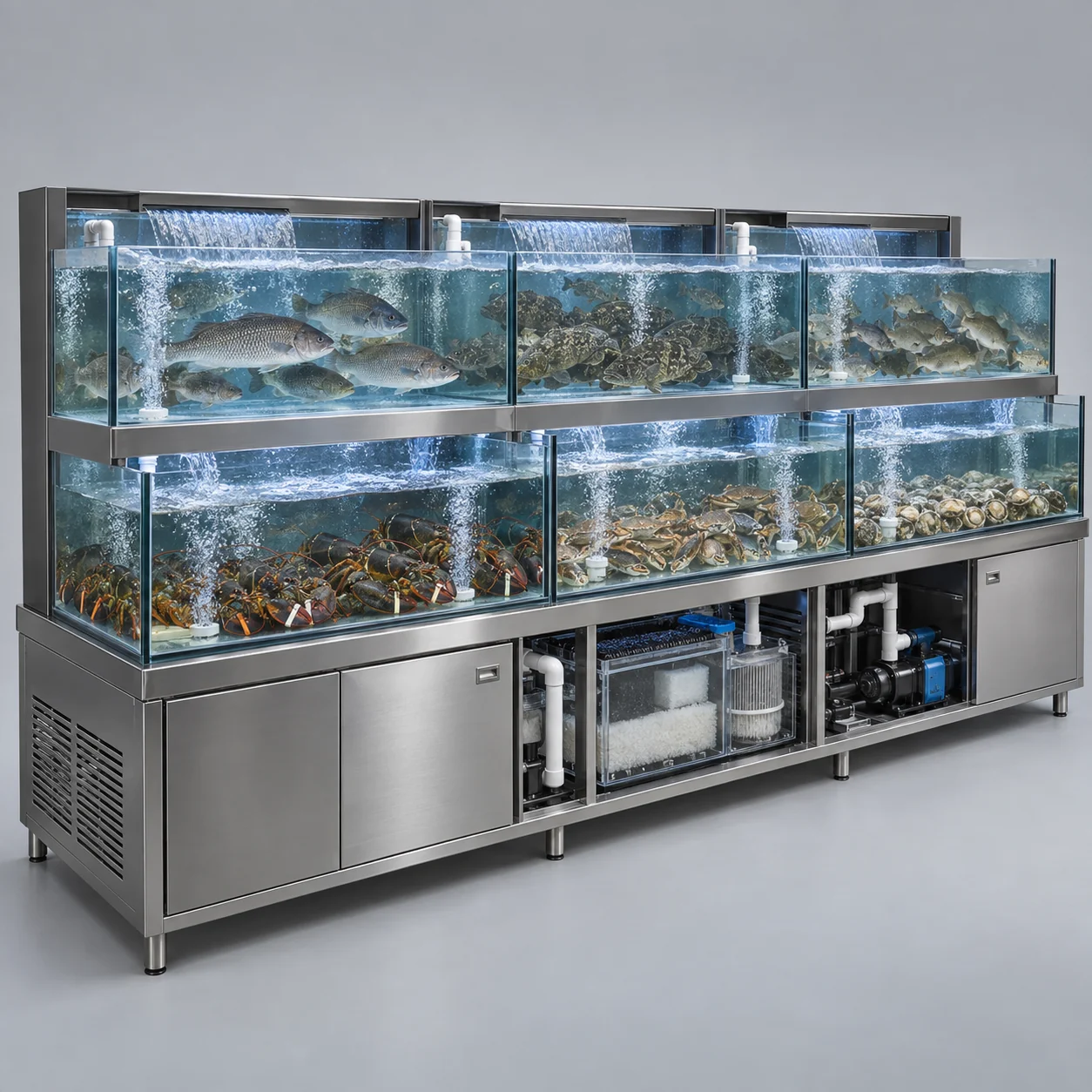
Commercial live seafood tanks for restaurants and supermarkets, with separate compartments for edible fish and shellfish.