What should the placement and circulation flow around the soup cooking stove be arranged as?
The layout of the soup cooking stove needs to consider both the customer side and the work side, not just placing the equipment in the floor plan as if it’s done. When a restaurant sets up an independent soup service station, actions such as viewing, taking, replenishing, and cleaning often occur around the equipment. The focus of the planning is to ensure these actions can be seamlessly connected in the same space, rather than simply aiming for neat equipment arrangement.
Draw up an action sequence from ingredient preparation, container placement to service handover, and separate the positions where service staff stay from the equipment operation positions. The surrounding environment and safety distances are determined by professionals based on equipment documentation. During measurement, record the wall columns, door openings, fixing facilities, and channels planned to be retained. Do not directly consider the blank areas in the photos as available locations. The range after opening the cabinet doors, drawers, or other movable components also needs to be verified. The usage area of the equipment and the positions required for professional maintenance should be clearly defined separately.
If a set of temporary materials is placed between the soup service port and the equipment, employees will need to adjust their positions every time they serve soup. Layout evaluation should focus on the complete service sequence and retain necessary operating space according to specific equipment requirements. When determining layout issues, first observe which action or time period causes the conflict, then discuss whether to adjust the equipment or the operation position. If only the orientation of the cabinet is changed without organizing the surrounding materials, the original waiting or detour problems may still occur.
It is recommended to conduct a simple simulation using actual containers, trolleys, or empty packaging. Regarding soup bowls, cooking pots, ingredient containers, and service utensils, demonstrations should be conducted for replenishment, removal, and organization, and record whether employees need to turn around repeatedly, whether they cannot see the labels clearly, and whether they intersect with the customer waiting area. A large number of holes does not mean a smoother process; If the production window and container turnover are not properly arranged, waiting will still occur between the equipment and service. Write down these observations next to the floor plan, which makes it easier to achieve consistent understanding than simply describing ‘a bit more spacious’.
Before the plan is finalized, have the equipment supplier review the installation conditions based on on-site photos and dimensions. The space, supporting facilities, and surrounding environment required for the equipment should be specified according to the selected model, not inferred from photos from other stores. Check the energy form, installation compatibility, container matching, and training content to determine which accessories fall within the supply scope. The delivery demonstration should cover both normal operations and scenarios requiring contact with service personnel. If renovations or changes occur to the product layout, the original drawings must be updated, and affected areas should be re-verified to ensure the actual implementation matches the original plan.
Related products
 Catering equipment
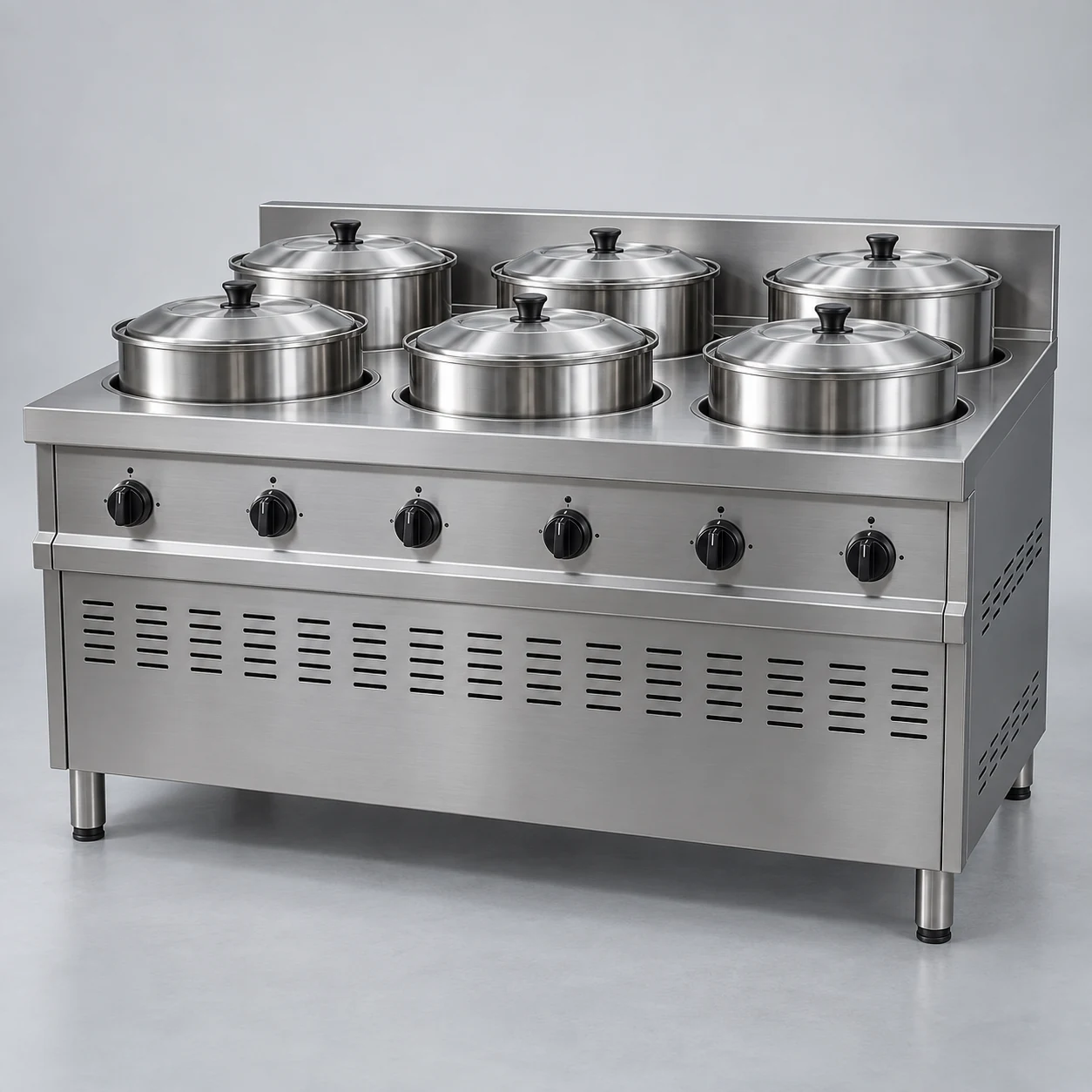
Soup simmering stoves
A soup preparation concept with heat source and stations configured to requirements.