How to keep maintenance information continuous in shift records for restaurant fish tanks?
Establish zone identification and professional maintenance records, and explain the observed changes and services contacted during shift handover. The display area aims for overall aesthetics, but maintenance space cannot be reduced at the cost of hiding all structures. For long-term use, accessibility should be included in the design considerations.
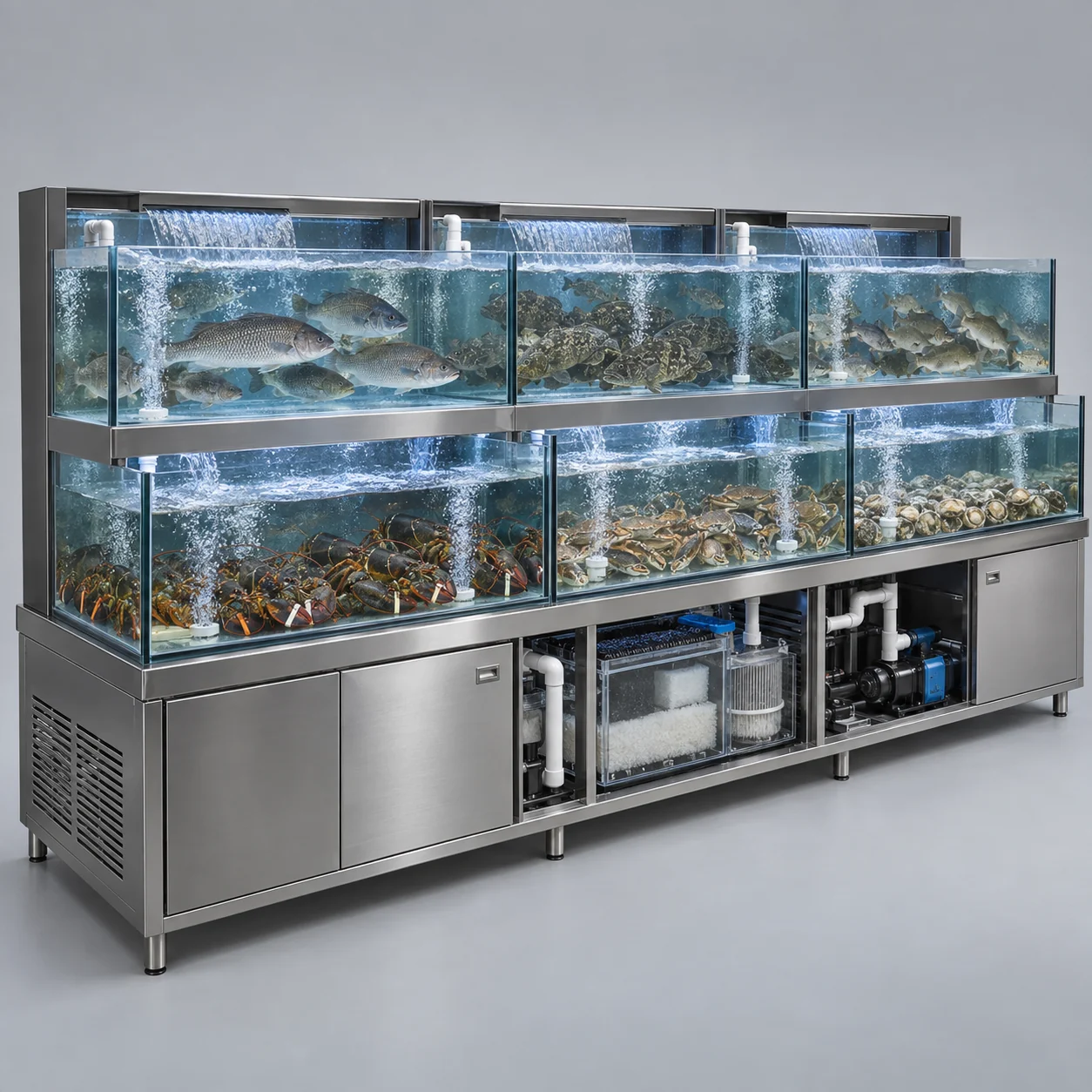
For daily management, first identify changes worth recording
Catering stores want to reserve an independent area for aquatic product display. After implementation, the management of the catering fish tank should not be limited to simply determining if it is functioning properly today. The rationale for normal operations needs to be understood by different shifts, and abnormal conditions should also be documented. Establish zone identification and professional maintenance records, and explain the observed changes and services contacted during shift handover. Employees should not adjust key systems arbitrarily based on experience; actions must follow clear management protocols and equipment requirements. The purpose of recording is to enable the next person to continue working, not to fill out forms.
The store can identify the handover points from the actual use of the partitioned aquatic product display, container accessories, labels, and maintenance tools: when items enter the working area, who organizes them, when they are removed, and which information needs to be updated after completion. Record items should be arranged around these handover points. For information that does not assist subsequent decision-making, there is no need to copy it mechanically every day; For situations that repeatedly cause inquiries, clear labels or location indicators should be added.
Establish consistent numbering and location descriptions consistent with the actual site.
Mark the viewing surface for customers, the operation surface for staff, and the maintenance location separately, to avoid fixed decorations covering parts that need inspection. Equipment compatibility with the site’s load capacity, water supply and drainage, and electrical infrastructure should be verified by the appropriate personnel. Based on such a site, assigning numbers and locations to equipment and common areas can transform handover references from ‘that machine over there’ into specific, identifiable objects. When a same product or container has multiple specifications, the name should also be differentiated to avoid records appearing consistent while referring to different items.
When establishing record items, you can start by focusing on situations where the item or configuration has changed. For example, if a restaurant wants to use the same set of tanks to display different items, it cannot assume the environmental requirements are the same simply based on visual grouping. It is necessary to obtain a professional description of the objects and environmental requirements before confirming the tank division and supporting system plan. Such information is suitable for recording separately based on the location of the issue, the nature of the change, the responsible person, and the next steps. After identifying a problem, do not immediately assume a guess as the cause, and do not leave the record at ‘notified’. During the handover, it is necessary to confirm that tasks have been completed, are still being followed up, or require new information, so that the next person knows where to continue from.
Separate the phenomenon, cause judgment, and handling results
When describing equipment issues, first write down the observed or heard phenomena, the time period, the corresponding number, and the usage task at that time. Do not assume ‘a certain component is broken’ as a definite conclusion from the beginning, especially avoid using self-adjustment of key components to prove a guess. Professional personnel with relevant experience should first clarify the target and environmental requirements, then discuss the equipment structure and zoning. Do not infer suitable species based on the appearance of the tank, and storage conditions should not be based on the assumption that it ‘looks large enough’. Understanding the applicable scope of the equipment helps distinguish the usage context and issues that require professional judgment.
Clearly documenting repetitive actions in the same location makes it easier to discuss improvements. For instance, if the aquatic display area plans to use fixed decorative panels to enclose the base, it is necessary to determine in advance which areas will serve inspection or maintenance functions. The display effects can be discussed, but relevant areas cannot be permanently sealed without corresponding feedback. Such information is suitable for recording separately based on the location of the issue, the nature of the change, the responsible person, and the next steps. After identifying a problem, do not immediately assume a guess as the cause, and do not leave the record at ‘notified’. During the handover, it is necessary to confirm that tasks have been completed, are still being followed up, or require new information, so that the next person knows where to continue from.
Organizing tasks also requires clear responsibilities and boundaries.
The display area aims for overall aesthetics, but maintenance space cannot be reduced at the cost of hiding all structures. For long-term use, accessibility should be included in the design considerations. Daily organization should serve practical use, not just focus on neatness during photography. You can observe whether employees repeatedly move items to complete the same task, or if they need to look for supporting tools in other areas. If these actions are repeated over time, examine storage locations, containers, or processes, rather than simply asking employees to speed up.
Handover isn’t just reporting a result, but delivering information needed for the next step of judgment. Take the restaurant fish tank as an example: if a new manager notices changes in a section, the record should include the section number, observed phenomenon, and any compliant actions taken, and be promptly handed over to the responsible person. Do not directly conclude that a malfunction or object condition exists based on unverified assumptions. Such information is suitable for recording separately based on the location of the issue, the nature of the change, the responsible person, and the next steps. After identifying a problem, do not immediately assume a guess as the cause, and do not leave the record at ‘notified’. During the handover, it is necessary to confirm that tasks have been completed, are still being followed up, or require new information, so that the next person knows where to continue from.
Let records over time become actionable improvements.
Determine who is responsible for the tank body, supports, supporting systems, on-site construction, and subsequent maintenance. Keep the design plan, accompanying instructions, and acceptance records at the store so that subsequent staff can trace the original requirements. Documents left during procurement and delivery remain valuable during daily management stages. When searching for models, accessories, and service ranges, they should be accessible from the same equipment file, avoiding the need to ask the original purchaser repeatedly when issues arise.
When reviewing records regularly, focus first on issues that occur repeatedly at the same location, during the same action, or at the same time period, then determine whether the issue lies with labeling, item arrangement, personnel handover, or equipment service. Each improvement should specify what is expected to be resolved, and verify whether changes have occurred in subsequent records. Consultations about BAONIER products can also be based on these real-world details. For catering fish tanks, clear management is evident when on-site personnel know what to look for, to whom to report, and which tasks remain unfinished.