How should a fresh meat locker be selected to match the actual business needs of the store?
When selecting a fresh meat display cabinet, it is necessary to clearly define business requirements first, and then compare the appearance and features of the equipment. Taking the reorganization of customers' purchasing and staff weighing processes in fresh meat stalls as an example, the first thing that needs to be organized is not how many units to purchase, but how the fresh meat, turnover pallets, and signage are stored, displayed, and circulated in different zones. The form of goods, personnel actions, and equipment functions are interconnected; only by clarifying these conditions clearly can there be a basis for comparison in subsequent plans.
Prepare a representative product list, and list the most common items, the largest sizes, and those with the most inconvenient handling. Differentiate between service-based picking and customer self-picking based on the sales method, then confirm pallet dimensions and required display area. Do not solely rely on the front length of the counter to determine capacity; actions such as turning around, picking up dishes, and temporary sorting should also be considered in the evaluation. If only giving the supplier a general product name, it is easy to overlook the details that truly affect usage; Bring packaging photos, container dimensions, and the quantity to be displayed, which is more helpful than simply asking ‘which one is the best’.
Suppose both deep and shallow trays are used in the fresh meat locker, where the trays can be placed, but the content visible to customers differs from the angle used by staff for picking up trays. The comparison should include two perspectives: the display side and the service side. Take photos separately when necessary to avoid evaluating the entire counter only from the front. Such inspections can be completed before confirming the plan, or can be included in the communication with the prototype. When comparing, use the same items and the same operating sequence, and record the differences between each plan. Do not judge suitability for long-term operation based on a single display or a design drawing.
Customers want to see more parts, while employees want to pick trays more efficiently; A suitable arrangement between display levels and rear operation depth is needed for the store. You can separate the conditions that must be met, the conditions desired, and the issues still to be confirmed. For example, what must be met are the purpose and on-site installation conditions, what is desired may be a more convenient display method, and the parameters that have not been confirmed should be provided by the supplier with technical details for the corresponding model.
Finally, convert the selection conclusions into a verifiable list: equipment purpose, physical dimensions, main configurations, applicable products, on-site conditions, and subsequent communication matters. Confirm detachable components inside the cabinet, pallet support methods, service side access space, and cleaning accessibility. Confidentialize temperature control requirements with specific product management regulations and equipment details, and do not treat general display diagrams as actual temperature commitments. Price and appearance can only be part of the comparison. Warranty boundaries, maintenance arrangements, and accessory availability should also be discussed before order confirmation. When specific temperature, load, and energy conditions are involved, refer to official model specifications and professional confirmation results.
Related products
 Supermarket refrigeration
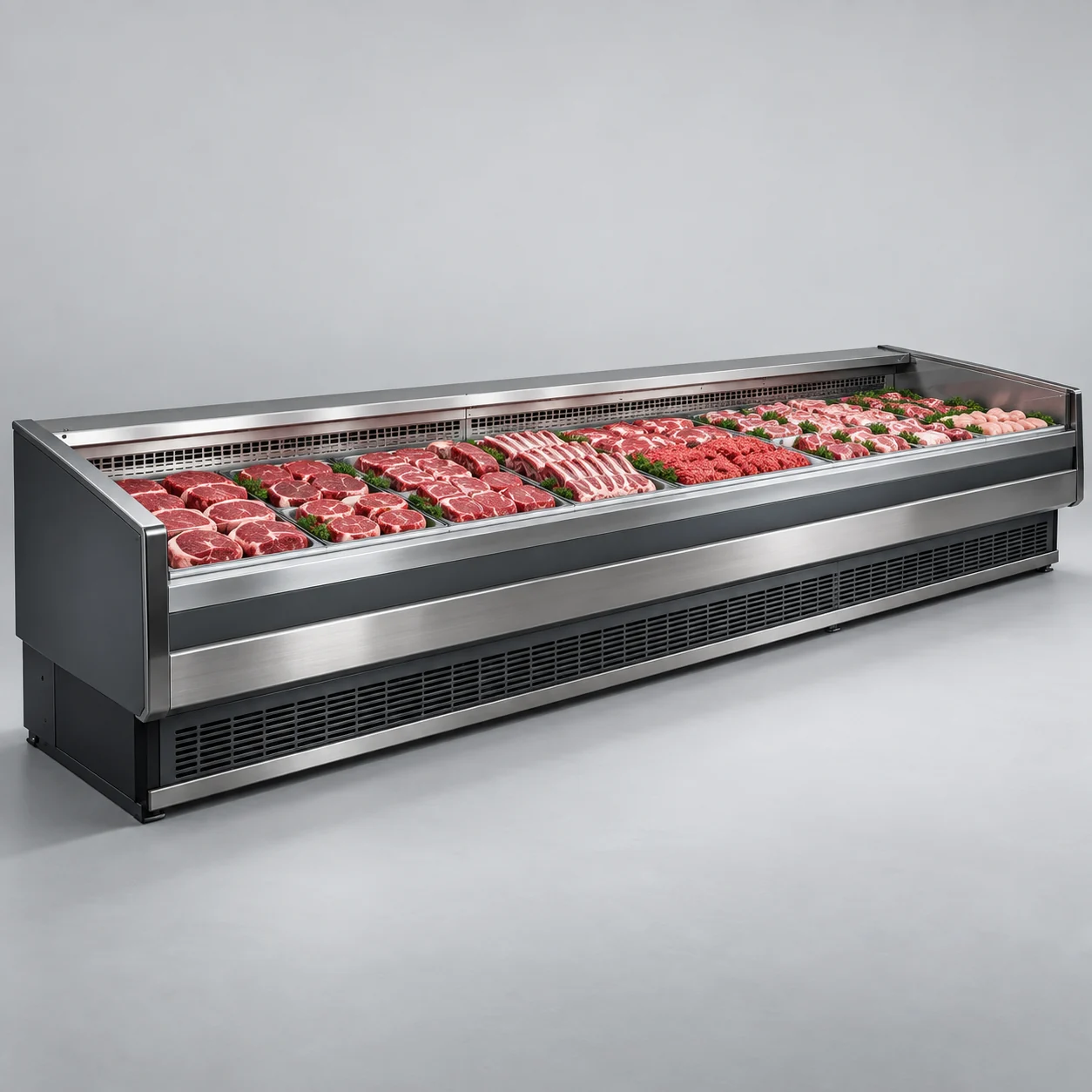
Fresh meat displays
An open-top fresh meat display without a curved glass canopy supports clear merchandising and counter access.